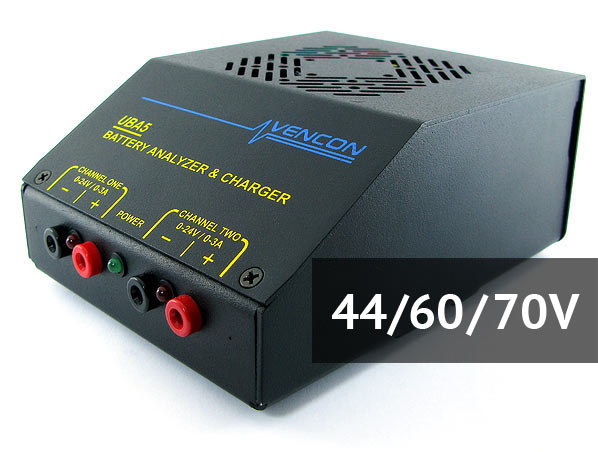
UBA5-44V
Analyze batteries that are higher in voltage than the standard UBA5 as shown below:
| Chemistry |
Maximum Battery Rated Voltage |
Maximum Number of cells |
| Lithium Ion or Polymer |
37V |
10 |
| Lead Acid or Gel Cell |
36V |
18 |
| NiCd or NiMH |
30 |
25 |
UBA5-44V Brochure
UBA5-60V
Maximum input of 60V, can analyze high voltage battery packs, as follows:
| Chemistry |
Maximum Battery Rated Voltage |
Maximum Number of cells |
| Lithium Ion or Polymer |
51.8V |
14 |
| Lead Acid or Gel Cell |
48V |
24 |
| NiCd or NiMH |
43.2 |
36 |
UBA5-60V Brochure
UBA5-70V
We also have a 70V UBA5 for 16S li-poly batteries:
| Chemistry |
Maximum Battery Rated Voltage |
Maximum Number of cells |
| Lithium Ion or Polymer |
59.2V |
16 |
| Lead Acid or Gel Cell |
56V |
28 |
| NiCd or NiMH |
49.2 |
41 |
UBA5-70V Brochure
The UBA5-60V and UBA5-70V come a small power supply (120VAC or 220VAC input) that powers the UBA5’s internal circuitry. The maximum charge current is 2A per channel (up to the charge power supply’s limit) and the maximum load is 2.4A per channel with a 45W limit per channel. You can use the UBA channel combiner to charge at twice that.
The charge power supply, which we don’t supply, needs to be of sufficient voltage and current to charge your batteries. The UBA5 will regulate the charge current.
Here are some suggestions for lab grade power supplies:
Instek PSP-405: 40V 5A
Instek PSP-603: 60V 3.5A
Instek GPR-7550D: 75V 5A
Instek SPS-606: 60V 6A
When testing batteries that are higher than 15V the UBA5’s power limit becomes the limiting factor during battery discharge. For example, the maximum discharge current on a 30V battery would be 1.5A (45W). If you want a higher current for the discharge then see our section on High Power Solutions.
Specs
Battery type: All chemistries, primary and secondary cells
Battery voltage: Single cell 59V pack
Battery capacity: 10mAh to over 100Ah
Charge current: Up to 2A per channel
Load current: 2.4A or 3A per channel depending on model
Load power: 45W per channel
Number of channels: 2
Interface: USB and Serial
Approvals: CE and FCC
(full specs in brochure)
Compare
Which UBA is best for you?
All UBA5 models have two channels and can network with each other. They differ by their maximum battery voltage and load current.
| Analyzer |
Power supply included |
Maximum Battery Voltage2 |
Maximum Discharge Current/Power
per channel(double the current & power when paralleling both channels) |
Maximum Charge Current
per channel(double the current when paralleling both channels) |
| UBA5 |
yes |
18.5V for lithium ion |
3A / 45W |
2.0A |
| UBA5-High Current |
yes |
18.5V for lithium ion |
12A / 45W |
2.0A |
| UBA5-High Voltage |
small1 |
Up to 59.2V depending on model. |
2.4A or 3.0A / 45W |
2.0A |
1 The small power supply is for powering the UBA5 only, it does not provide the charge current.
2 The maximum battery pack voltage depends on the battery chemistry.
Notes:
- All UBA5s come with a serial and USB cable, battery cables, software, manual, and unlimited technical support from our engineering department.
- All UBA5s can discharge at up to 3A per channel (2.4A for UBA5-60V/UBA5-70V) with a 45W per channel limit
- All UBA5s can test battery packs down to a single cell, any chemistry
- All power supplies are universal input, i.e. they work in North America, Europe, or Asia.
Support
Get the latest Software Version and User Manual pdf on the Support Page

 Windows 10 Compatible